Somewhere around the second week of September, the office thermostat wins the argument your bare legs have been having with the weather since June. The dresses stay in rotation — nobody wants to pack away a wardrobe that still feels current — but the legs underneath need backup, and most women reach for the wrong denier, buy the wrong brand, and end up with a laddered pair by the second wear. Sheer tights are back on every editor's shopping list this month, and the denier number on the packet matters more than the price tag.
Why denier is the number nobody explains properly
Denier measures the weight of the yarn, not the opacity or the warmth, and the two don't always move together the way people assume. A 20-denier pair reads as "your skin, but slightly smoothed" — the classic nude-effect sheer that disappears under a hemline and works for anything from a client meeting to a wedding. Once you cross into 40 denier, the tights start doing visible work: legs look more matte, veins and knee shadows vanish, and the fabric holds up to a full day of walking without the toe seam giving out by 3pm. Anything above 60 denier stops behaving like hosiery and starts behaving like a legging — opaque, warm, built for October rather than the first cool week of fall.
Wolford's Individual 10 is the reference point the whole category gets measured against, and at around $58 a pair it should be — the yarn is reinforced at the toe and waistband in a way that actually survives repeated wear, not just repeated washing instructions. Calzedonia's 20-denier "Invisible" line runs closer to $16 and does 80% of the job for a fraction of the cost, which makes it the more rational buy for anyone who ladders a pair every six weeks anyway. Spanx sits in a different lane entirely: their Reversible Tights, around $38, are the ones to buy if shaping matters as much as sheerness, since the compression through the waist and thigh is real, not a marketing claim.
What actually goes wrong when people buy tights
The most common mistake isn't denier — it's undersizing. Tights sold by height-and-weight band rather than by dress size fit differently across brands, and buying a size down "for a snugger look" is exactly how a 20-denier pair ladders on the first wear; the yarn is already stretched past its comfortable range before your first step out the door. Check the sizing chart on the actual packet, not the general size you'd wear in trousers, and size up if you fall between two bands.
The skin-tone problem the industry is still catching up on
For years, "nude" tights meant one shade, and it wasn't nude for most people. That's changed — Nubian Skin built an entire brand on filling the gap with a proper range of deep tones, and mainstream players like Wolford and Falke have quietly expanded their nude offerings to four or five shades instead of one. If your local department store still stocks a single "nude," that store is behind, not the category.
Buy the shade that matches your actual skin at the wrist, not the ankle — ankles run lighter or darker than the rest of the leg depending on tan lines and circulation, and matching there throws the whole leg off by a shade. Hold the tights up against your inner wrist in daylight before you commit, not under the yellow lighting of a fitting room.
- 20 denier: sheer, nude-effect, best for daytime professional wear and warmer transitional days.
- 30–40 denier: the September-to-October workhorse — opaque enough to skip the "are my legs cold" question, sheer enough to still read as tights rather than leggings.
- 50+ denier: save it for actual cold, paired with boots rather than open shoes.
- Control-top styles: worth it under a fitted sheath dress; skip them under anything loose, where the shaping does nothing but trap heat.
Styling them without looking like you gave up on summer
The single biggest style shift this season is sheer black tights under a slip dress — a combination that read as slightly gothic five years ago and now reads as simply autumnal, especially paired with a loafer or a Mary Jane rather than a boot. Wear them with the hem you'd otherwise show bare legs under; there's no rule that tights require a longer skirt, and the visual trick of skin-toned mesh under a mini often reads more polished than the same outfit with nothing underneath.
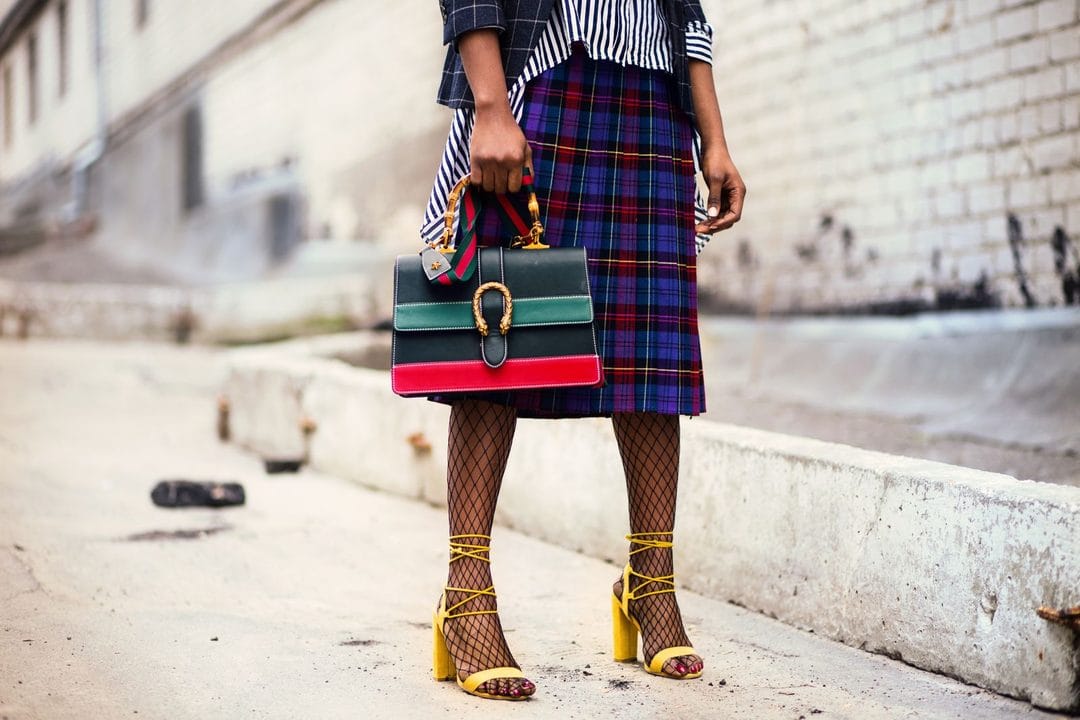
Patterned tights are the one category worth a real opinion: fishnet works with a tailored skirt and a structured bag, the way street-style photographers have been shooting it for two seasons running, but skip fishnet under anything already busy — a printed dress with fishnet legs is one pattern too many, and it reads as costume rather than outfit.
Colors are doing more work than usual this season
Black is still the default, and it's still correct most of the time. But the tights showing up on run-of-show street style this month lean warmer than the last few autumns — chocolate brown and a deep burgundy are both turning up under skirts in the same shade family that's already driving this season's nail polish and handbag choices, which makes a brown or burgundy pair a genuinely useful bridge piece rather than a one-outfit purchase. A burgundy 40-denier pair under a camel skirt reads considerably more expensive than the actual price tag, mostly because the tonal match tricks the eye into treating the whole outfit as one deliberate palette instead of separate pieces.
Grey is the color to be careful with. It photographs beautifully and reads as effortlessly Scandinavian in every editorial spread — and then looks slightly washed-out or faintly medical on most actual skin tones in office lighting. If grey tights are non-negotiable, keep them to a charcoal rather than a true mid-grey, and pair them with black rather than another neutral to anchor the look.
Shopping by budget, not just by brand
At the top end, Wolford and Falke are worth the price if you wear tights three or more days a week through fall and winter — the cost per wear drops fast, and the reinforced toe genuinely survives longer than a $12 pair replaced monthly. In the middle, Calzedonia and Uniqlo's Heattech sheer tights (around $15) both do the job well for anyone who wants one or two reliable pairs without treating hosiery as a luxury category.
Skip the tights sold in three-packs at fast-fashion chains for anything beyond a backup pair kept in a desk drawer for emergencies. The yarn on those is thinner than the denier number suggests, and they're built to survive exactly one wear at the stated opacity — after that, the compression starts to sag at the knee, which is the first place a cheap pair visibly fails.
Care that actually extends the life of a pair
Hand-washing sheer tights in cool water adds real weeks to their life, and most people skip it entirely. The washing machine's spin cycle is what shreds delicate yarn at the toe seam — if a machine wash is unavoidable, a mesh lingerie bag on the gentle cycle cuts the damage significantly. Store them flat or loosely rolled, never twisted, and keep long nails away from the packet until you're actually pulling them on; more pairs die in the first thirty seconds of wear than in the following month of it.
Buy two pairs of whatever denier you actually reach for, not one — tights run out at the worst possible moment, usually while you're already dressed for somewhere you can't be late to, and a spare in the drawer is cheaper than the cab fare to replace one on the way out the door.